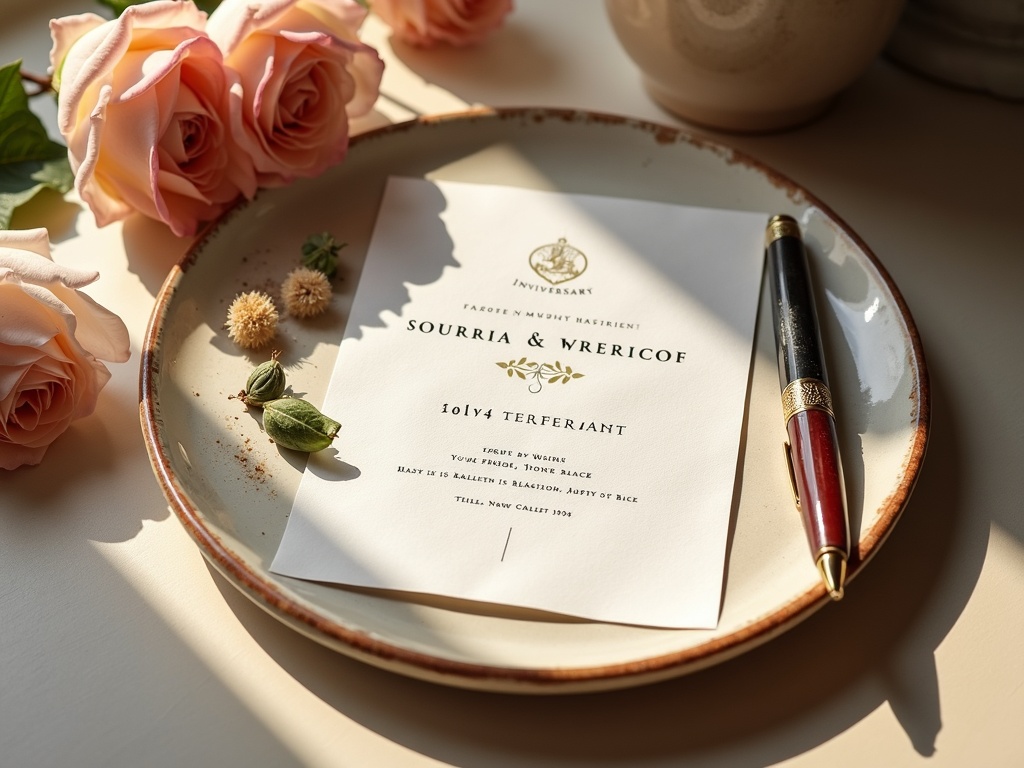
Thirty years ago, you sent a wedding invitation. Now you're planning a party to mark what came after — the ordinary Tuesdays, the hard winters, the inside jokes that have outlasted everything. That invitation needs to do something different.
What Anniversary Invites Need That Wedding Invites Don't
A wedding invitation announces a beginning. An anniversary invitation reflects on something already built. That shift changes everything about the tone. Where wedding copy tends toward the ceremonial and forward-looking, anniversary party wording works best when it carries a sense of earned warmth — something that says *we made it*, without being saccharine about it.
It also needs to be more practical. Wedding guests expect a certain formality and a long lead time. Anniversary guests — often a tighter circle — want to know quickly: is this a sit-down dinner or a garden party? Are children welcome? Is there a speech? The wording has to carry that information without feeling like a logistics memo.
Finally, anniversary invites often come from a more complex authorship. Sometimes the couple writes them together. Sometimes adult children organise the whole thing as a surprise. Sometimes it's just one partner, quietly planning something for the other. Each of those scenarios calls for a slightly different voice.
Three Tones, Three Sets of Words
Good anniversary invite copy starts with an honest read of your guest list and your own personality. Here are three approaches, each with a concrete example.
**Formal.** Useful for milestone anniversaries — 25th, 40th, 50th — where the occasion genuinely warrants ceremony.
*Margaret and David Osei request the pleasure of your company at a dinner celebrating fifty years of marriage. Saturday, the fourteenth of June, seven o'clock in the evening. The Ned, London. Black tie. RSVP by the first of June.*
**Warm.** The middle ground most couples land on — personal but not precious.
*Twenty-five years ago we made a promise. We'd love to celebrate with the people who've kept us honest. Join us for dinner and dancing on Saturday 14 June at Chez Bruce, London. Seven o'clock. Smart casual. Kids welcome. Let us know by 1 June.*
**Quiet/Intimate.** For a small gathering — ten people around a table, or a weekend away with close family.
*We're marking thirty years quietly, with the people we love most. Dinner at ours, Saturday 14 June, seven o'clock. No gifts, just you.*
Notice that each version gives the same essential facts — date, time, place, dress, RSVP — but the emotional register is completely different. The formal version uses full names and spelled-out numbers. The quiet version doesn't even mention an RSVP deadline, because if you're inviting ten people you already know, you'll just text them.
Renewal of Vows — Wording That Respects the Original Day
Renewal of vows wording sits in its own category. It's not quite a wedding invitation, and it's not quite a party invitation. The ceremony is real, but it's also a choice — an act of intention rather than a first declaration. The wording should honour that distinction.
Avoid language that mimics a wedding invitation too closely. Phrases like *you are cordially invited to witness the marriage of* feel odd when the couple has been married for twenty years. Instead, try something like: *After twenty years, we're choosing each other again. We'd love you there when we do.*
If there's a reception following the ceremony, mention it clearly — guests often aren't sure whether a vow renewal is a brief ceremony or a full evening. Something like: *Ceremony at three o'clock, followed by dinner and dancing* removes any ambiguity.
When the Children Are Doing the Inviting
Adult children hosting a surprise anniversary party for their parents face a specific wording challenge: the invitation has to come from them, not the couple, without feeling awkward.
Keep it simple and direct:
- Lead with the relationship: *On behalf of the Osei family, we're celebrating our parents' fortieth anniversary.*
- Mention the surprise element early so guests don't accidentally spoil it: *This is a surprise — please don't mention it to Margaret or David.*
- Include a contact name and number for questions, so guests don't reach out to the couple by mistake.
- If children of different ages are co-hosting, list them in birth order or alphabetically — it avoids any perceived favouritism.
The tone here can be warmer and more personal than the couple might write for themselves. Children often have a different view of their parents' marriage — one that's worth expressing.
Keeping the Warmth Across Languages
Many anniversary celebrations bring together guests from different countries, and if you're sending invitations in more than one language, the challenge isn't just translation — it's tone. A warm English phrase can read as overly casual in French, or too formal in Brazilian Portuguese.
Rather than running your copy through a translation tool and hoping for the best, write the emotional intent first — *we want guests to feel welcomed and a little moved* — and then ask a fluent speaker to write fresh copy in that language with the same intent. A direct translation of *we made it* might land flat; the equivalent idiom in another language might be entirely different.
Venito supports multilingual invitations, so you can send the same event with language versions tailored to different guest groups — useful when one side of the family is in Lagos and the other is in Oslo.
The best anniversary invitation wording, in any language, does one thing well: it makes the guest feel that their presence at this particular celebration genuinely matters. That's not about formal versus casual. It's about writing something true.