Your grandmother in Beirut shouldn't have to ask your cousin to translate her own invitation. Your partner's family in Osaka shouldn't squint at a romanised version of their language and wonder if the venue name is correct. A multilingual wedding invitation isn't a courtesy — it's the first signal that every person on your list actually belongs at this wedding.
Getting there without producing a cluttered, confusing document is the real challenge. Here's how to do it.
The Hidden Cost of Sending One Language
Most couples default to English because it feels like the safe, universal choice. And for guests who are fluent, it works fine. But fluent and comfortable are different things. A guest who reads English as a second language can decode your invitation — and still miss the dress code, misread the RSVP deadline, or feel, quietly, that this event was designed for someone else.
That feeling matters. An international wedding draws people from different countries, different generations, and different relationships to English. Your 75-year-old great-aunt in Guadalajara may have learned English in school fifty years ago. She can manage. But imagine receiving your own granddaughter's wedding invitation in a language you have to work at. The warmth of the occasion gets lost in the effort.
The practical cost is real too. Guests who aren't confident in the invitation language are more likely to RSVP late, choose the wrong meal option, or arrive at the wrong time because they misread a detail. A multilingual wedding invitation isn't extra effort for its own sake — it's risk reduction.
Side-by-Side, Back-to-Back, or Two Separate Cards?
This is the layout question every couple with a bilingual wedding invitation faces, and the answer depends on how different your languages are — visually and structurally.
**Side-by-side columns** work well when both languages use the same script and have similar text length. English and French, for example, sit comfortably next to each other. The problem is that some language pairs produce wildly different column lengths — Spanish tends to run longer than English, and German longer still — which creates awkward white space on one side.
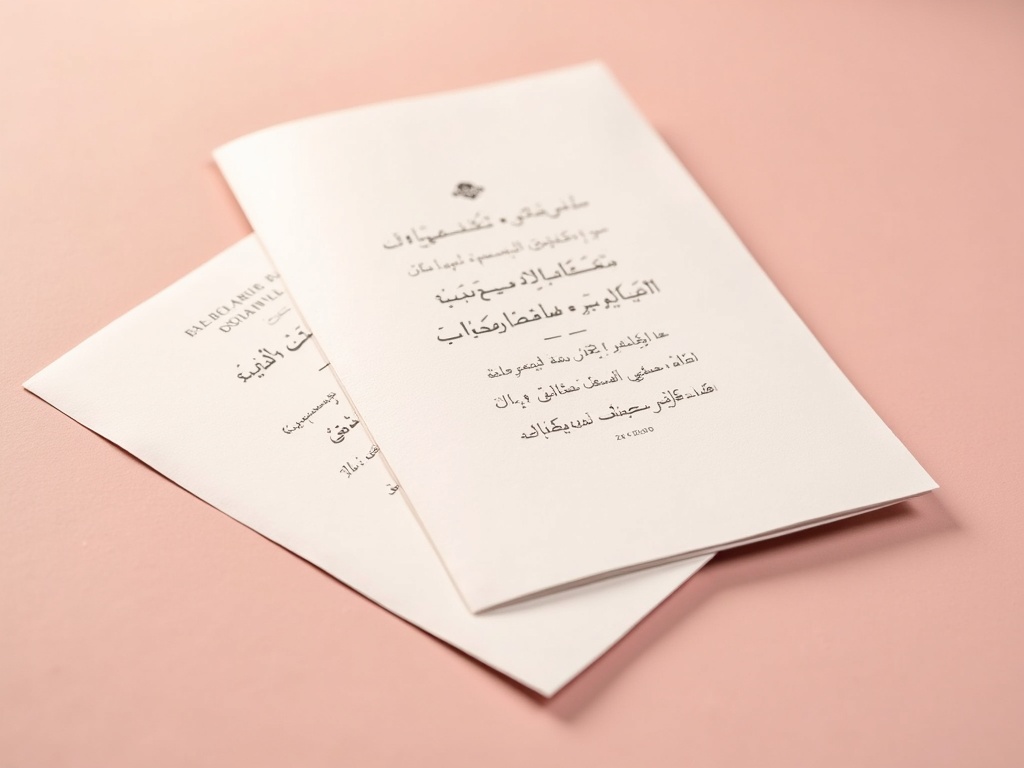
**Back-to-back (flip format)** is cleaner for script-different pairs. English on the front, Arabic on the back, each reading naturally in its own direction. This is the standard approach for an Arabic-English wedding card, and it works because neither language has to compromise its layout for the other. The card feels complete in both directions rather than crowded in either.
**Two separate inserts** give you the most design freedom and are worth considering when you have three or more languages, or when one language requires significantly more text. You can match the paper stock and typeface family to keep the suite cohesive, while letting each language breathe on its own card.
Names, Scripts, and the Transliteration Problem
Names are where multilingual invitations most often go wrong. The temptation is to transliterate everything — to write "Yuki" in Roman letters on an otherwise Japanese-script card, or to render "محمد" as "Mohammed" for an English-language section. Sometimes that's necessary. Often it creates more confusion than it solves.
A few principles that hold across most language pairs:
- Keep names in their original script wherever that script is being used. If the Arabic section of your card exists, write Arabic names in Arabic.
- For transliteration into Roman letters, pick one system and use it consistently. The name "Siobhán" should appear the same way every time it appears in English text — don't let a copy-paste from different sources give you three different spellings.
- Right-to-left (RTL) scripts — Arabic, Hebrew, Persian — require RTL text direction in digital tools, not just a font change. A word processor that doesn't support RTL will mirror or scramble your text in ways that look fine on screen but print incorrectly.
- Diacritics matter. "José" and "Jose" are not the same name to the person who owns it. Check with family members rather than guessing.
If you're working with a language you don't read, have a native speaker review the final proof — not just the translation, but the layout. Spacing and punctuation conventions differ, and a misplaced comma in Arabic reads very differently from one in English.
Dates, Times, and the Calendar Question
The Gregorian calendar is not universal. Guests from Ethiopia, Iran, or observant Jewish communities may use a different calendar system in daily life. For most international weddings, it's enough to include the Gregorian date clearly — but if a significant portion of your guest list uses a different system, adding the equivalent date in parentheses is a small gesture that lands well.
Time zones are a more pressing issue for destination weddings or ceremonies with remote-viewing components. If your ceremony is at 4 PM in Rome and you're inviting guests watching from Toronto, state both times. "4:00 PM CET (10:00 AM EST)" removes ambiguity entirely.
AM/PM notation isn't globally standard. In many countries, 24-hour time is the norm, and "7 PM" reads as slightly foreign. If your invitation is going to guests in Germany, France, or much of Latin America, consider writing "19:00" alongside the 12-hour version. It takes four characters and eliminates a category of confusion.
Translating Tone, Not Just Words
A direct translation of "Together with their families, Amara and Luca request the pleasure of your company" into formal Japanese will read as stiff and distant in a way the English doesn't intend. Formal registers, honorifics, and the conventions around announcing a wedding vary enormously between languages.
This is why machine translation — even very good machine translation — isn't enough for a wedding invitation. The words may be accurate and the grammar correct, and the result can still feel wrong to a native speaker. Hire a human translator, ideally one who has translated social correspondence before, not just legal or technical documents. Ask them to match the warmth and register of your original, not just the content.
If budget is a constraint, prioritise human translation for the body of the invitation — the personal parts. Venue names, addresses, and RSVP instructions are lower risk for machine translation because they're factual rather than tonal.
Handling Four Languages Without Losing Your Mind
Most professional designers don't work in more than one or two languages. Finding someone who can handle Arabic, English, Japanese, and Spanish in a single suite — with correct RTL support, appropriate typefaces for each script, and consistent design — is genuinely difficult.
This is where a purpose-built digital platform earns its place. Venito's invitation builder supports multiple languages within a single design, with RTL text direction handled automatically for Arabic and Hebrew, so you're not fighting your tools. You can set up language-specific versions of the same invitation, send each guest the version in their language, and track RSVPs in one place regardless of which version they received.
If you're printing physical cards, export each language version separately and proof them with a native speaker before sending to the printer. Digital and print can work in parallel — some couples send a digital invitation first, then follow with a printed card for immediate family.
The goal throughout is an invitation that reads as if it was written for that guest, in that language, from the start — not translated as an afterthought. When you get that right, the invitation itself becomes part of the welcome.